
Blog
Redefining Neurodevelopmental Care: Why Dr. Dilip Karnik Calls OpenMind a Clinical “Game Changer”
If you ask clinicians what pulled them toward neurodevelopmental medicine, they will tell you about the patients. They will talk about the breakthroughs, the subtle milestones, and the trust built with families over years of careful observation.
What they will not mention is the administrative grind that steals those very moments away.
For most clinicians, everyday practice is fragmented by two exhausting realities. The first is documentation: hours spent wrestling with rigid EHR screens. The second is evidence: literature searches across a dozen tabs just to untangle a complex presentation. When a doctor is forced to stare at a keyboard during an appointment, the human connection suffers.
We built OpenMind to give that time and focus back. As our Chief Medical Officer Dr. Dilip Karnik often points out, AI in specialty care cannot be a novelty. It has to earn a doctor's trust, stand up to clinical scrutiny, and melt into the background so doctors can look their patients in the eye again.
Here is what happened when Dr. Karnik brought OpenMind into his daily practice.
The Pre-OpenMind Reality: Searching in the Dark
Before OpenMind, handling complex cases meant navigating a daily tug-of-war between uncurated web searches and slow medical databases. As Dr. Karnik recalls, turning to Google often felt inadequate because it simply was not designed as a scientific tool, while digging through PubMed meant losing precious time between back-to-back appointments.
When caring for neurodiverse patients with overlapping conditions, spending 40 minutes digging through paywalled papers just to double-check a treatment pathway or verify a rare presentation is unsustainable. Clinicians do not need generic web results; they need fast, verified, and clinically relevant answers right in the exam room.
Real-Time Clinical Intelligence: Deep Research
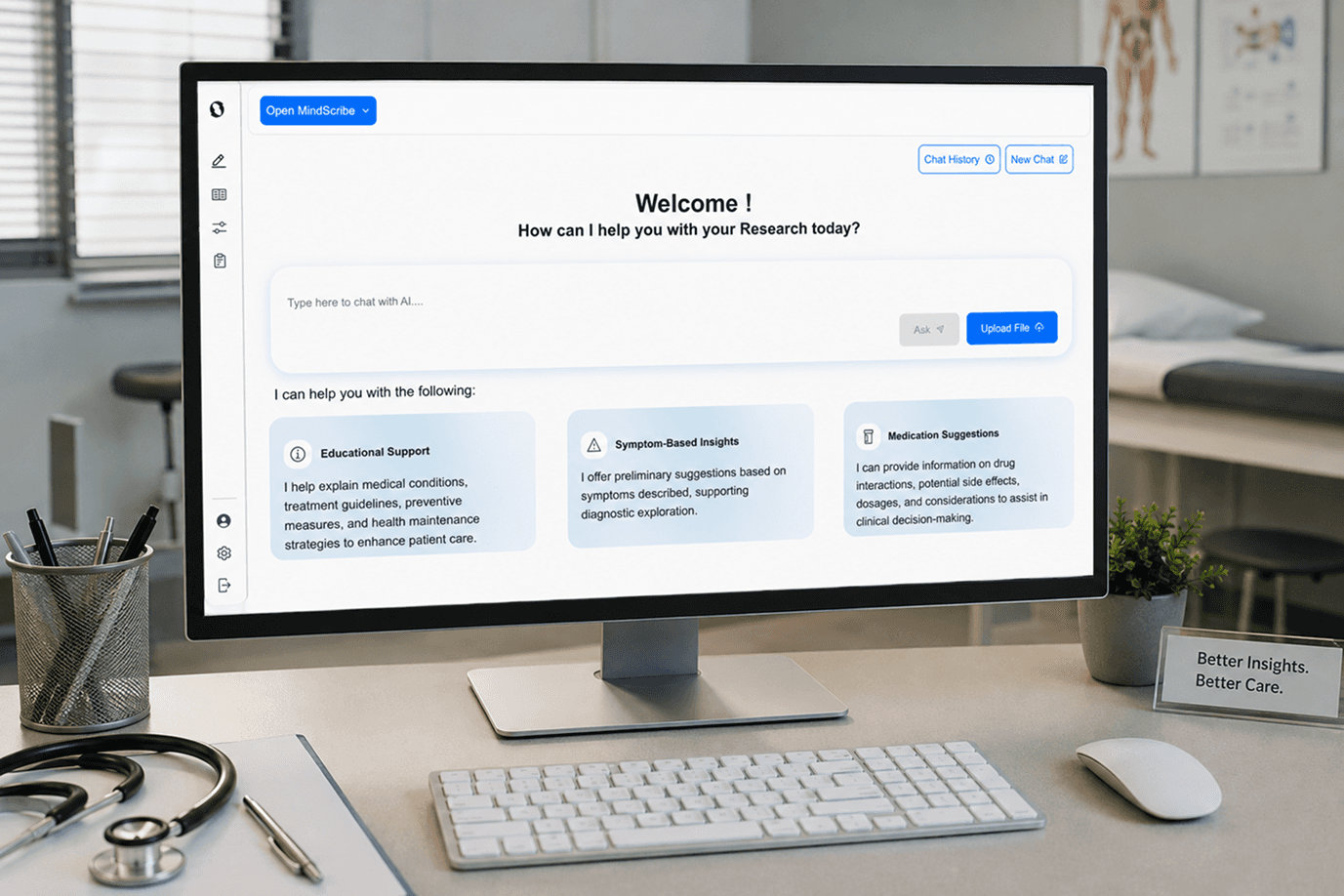
To solve this, we created Deep Research to act as a reliable clinical co-pilot. Deep Research puts current treatment guidelines, literature summaries, and dosing references in one place, each with the citation attached. It is fast enough to use while the patient is still in the room. Every citation can be reviewed and verified on the spot.
That speed shows up in the exam room. In a recent case involving rare abnormalities on a patient’s whole exome sequencing test, Dr. Karnik used Deep Research to surface the published literature on those variants. Reading it, he recognized a link to an underlying syndrome the care team had not yet considered. The genetic data was always there. What changed is how fast a clinician could make sense of it.
Eye Contact Over Keyboard Clicks: MindScribe and Casebook
The biggest change in clinic is not just faster answers; it is what happens in the room between provider and patient.
MindScribe listens through the visit and returns a note already structured for neurology, in SOAP or a template Dr. Karnik controls. Any scribe can capture what was said. The difference is that a note arrives organized the way a specialist thinks, so the review takes a minute instead of a rewrite. The effect in the room is simpler: he can maintain eye contact, read subtle behavioral cues, and genuinely listen instead of typing through the entire visit.
A full caseload stays manageable in Casebook, where every visit adds to one continuous record rather than starting a new one. It is the record every other feature writes into, so longitudinal history is never reset between visits. Cognitive assessments ordered through OpenMind sync back into it automatically.
What Better Clinical Care Feels Like
When asked what he would tell colleagues who have not used OpenMind, Dr. Karnik does not hedge. He calls it a game changer, and then he gets specific: “You must have it now! I wish I had it for many years.”
Technology in healthcare should never act as a barrier between people. By taking over the heavy documentation and cognitive load, OpenMind gives clinicians their energy and attention back so they can do what they do best: listen, assess, and treat.
Advances in autism research specifically in areas of neuroplasticity, photo biomodulation and PEMF